Bentham's Panopticon

Bentham's panopticon represents a powerful idea about surveillance, discipline, and architecture that still shapes how we think about institutions today. The image of a central tower watching over rows of cells captures a way of organizing power that feels both efficient and unsettling. In this exploration, we will look at how Bentham designed this circular prison, why he believed constant visibility could reform behavior, and what later critics discovered about the hidden costs of such control.
The Origins of Bentham's Panopticon Vision
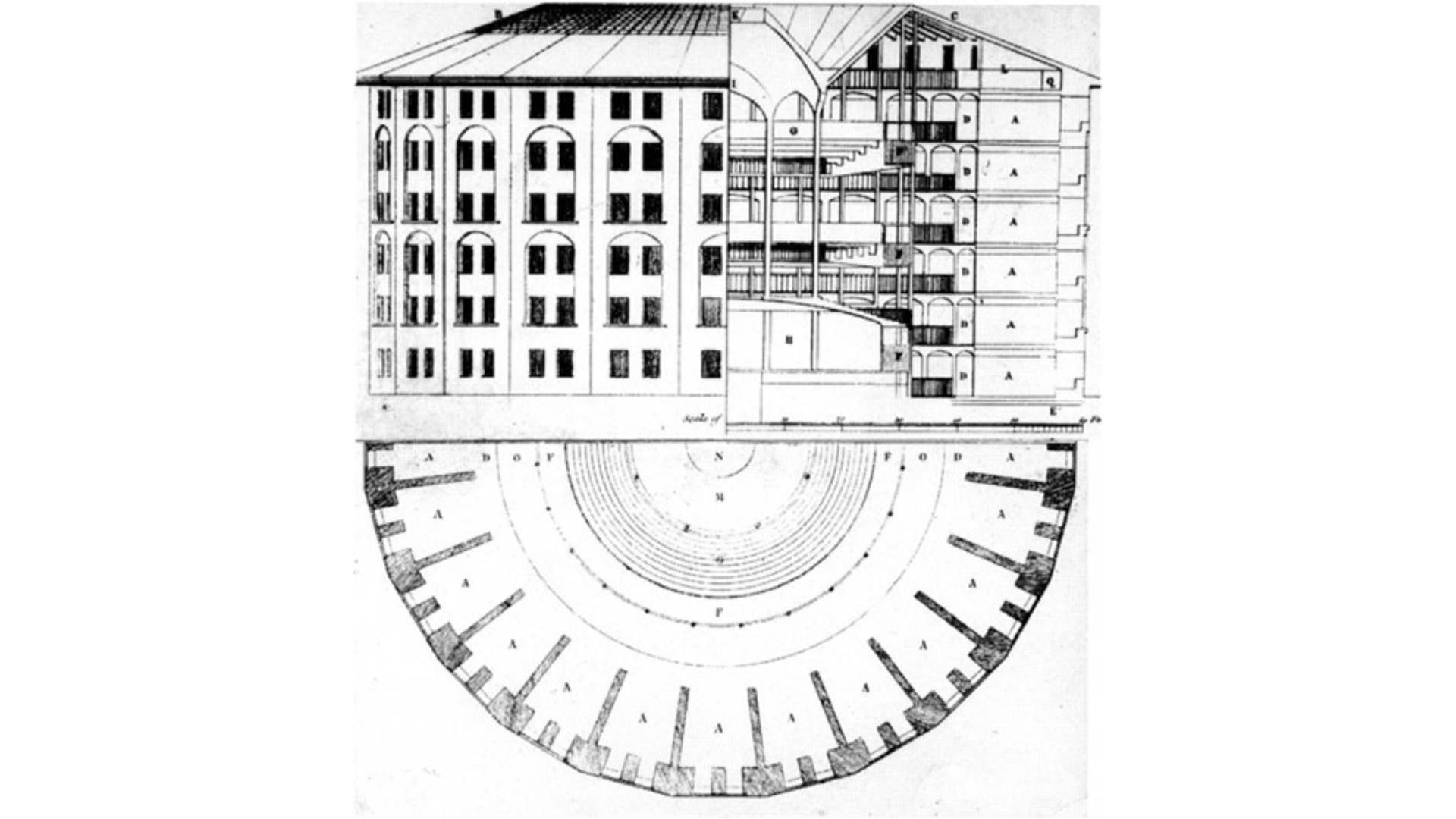
Jeremy Bentham first described his panopticon in the late eighteenth century, proposing a circular building layout that allowed one guard to oversee many prisoners without them knowing whether they were being watched. He imagined that the uncertainty of surveillance would encourage each person to regulate their own conduct, simply because they could never be certain when the observer was looking. For Bentham, this design promised a new kind of institutional efficiency, reducing the number of guards needed while maximizing the psychological impact of observation.
Bentham presented the panopticon as a solution for prisons, but also as a model for schools, factories, hospitals, and any setting where authorities wished to manage large numbers of people. He believed that transparency for the watcher and invisibility for the watched would create a rational system of discipline. In his notes, he emphasized that the architecture itself would do much of the work of control, making power feel calm, continuous, and almost invisible to those being governed.

How the Panopticon Architecture Works
The key feature of Bentham's panopticon is its circular ring of individual cells surrounding a central tower. The cells are arranged so that each inmate faces inward, toward the tower, while the tower's windows look out onto the circle. By using angled mirrors or careful positioning of light, the observer in the tower can see into each cell, but the people inside cannot easily tell whether they are being observed at any given moment.
- Central tower: From this vantage point, the observer has a panoramic view of the entire circle.
- Individual cells: Each person is confined in a small space with minimal privacy, visible to the central point.
- Uncertainty of being watched: Because inmates cannot know when they are under observation, they are encouraged to behave as if they always are.
This layout turns architecture into a tool for shaping behavior, suggesting that the design of space can quietly enforce rules without constant physical intervention. The idea is that people internalize the gaze of authority, adjusting their actions even when no one is explicitly commanding them.
The Panopticon as a Metaphor for Modern Power
Beyond prisons, Bentham's panopticon has become a metaphor for any situation where people feel monitored by unseen systems. Schools, workplaces, online platforms, and even smart devices can create a sense of continuous observation, not through a literal tower, but through data collection, cameras, and tracking technologies. The modern version of the panopticon is less about stone walls and more about algorithms, dashboards, and surveillance networks that quietly shape behavior from a distance.

When people believe they might be judged or recorded at any time, they often regulate themselves, following norms and rules without needing direct supervision. This self-discipline can be efficient for institutions, but it also raises questions about freedom, autonomy, and who holds the power to decide what is being watched and why. The panopticon metaphor invites us to ask whether constant visibility truly leads to better behavior or simply to more subtle forms of control.
Critiques and Limitations of the Panopticon Model
Many critics have argued that Bentham's panopticon relies on an imbalance of power, placing the observer in a position of near total control while those being watched have little say in how they are observed. Michel Foucault, in his analysis of discipline and punishment, described the panopticon as a symbol of disciplinary power that turns individuals into objects of study, classification, and normalization. According to this view, the architecture does not merely monitor behavior; it shapes identities, encouraging people to conform to institutional expectations out of fear of judgment.
- Power imbalance: The observer is hidden, while the observed is exposed, creating an uneven relationship.
- Psychological effects: Constant awareness of potential surveillance can cause stress, self-censorship, and a loss of authenticity.
- Resistance and adaptation: People often find ways to subvert or reinterpret the gaze, turning surveillance back on those who wield it.
These critiques highlight that Bentham's panopticon is not just a physical design but also a political and ethical framework. It suggests that how we watch, and why we watch, matters as much as the technology or architecture used to enable surveillance.
The Panopticon in the Digital Age
Today, many see variations of Bentham's panopticon in digital monitoring, from social media tracking to workplace software that records keystrokes and online activity. The principles of unseen observation and self-regulation still apply, but the scale and speed have changed dramatically. Algorithms can analyze vast amounts of data, making decisions about access, opportunity, and risk in ways that feel distant yet deeply personal.
Understanding Bentham's panopticon helps people think more critically about these systems, recognizing when visibility is being used as a tool of control and when it might serve genuine safety or accountability. The challenge is to design institutions and technologies where transparency works both ways, protecting individual dignity while still preventing harm. In this sense, the panopticon remains a useful lens for examining the trade-offs between security, freedom, and power in everyday life.
Reimagining Surveillance Beyond the Panopticon
While Bentham's panopticon highlights the risks of one-way observation, newer approaches emphasize accountability, participation, and shared governance. Instead of a single tower watching many, some systems encourage open dialogue, clear rules, and mutual oversight between institutions and the people they serve. This shift moves the focus from pure control toward trust, collaboration, and respect for rights.

By studying Bentham's panopticon, people can better question who is watching, why, and with what consequences. This awareness opens the door to more democratic forms of monitoring, where surveillance is justified by public benefit, limited by law, and subject to ongoing debate. In the end, the legacy of the panopticon is not just a historical curiosity but a prompt to think carefully about how visibility, power, and freedom intersect in the spaces we build and the systems we create.
Jeremy Bentham’s ‘perfect’ prison | The Panopticon
A precise digital construction of Jeremy Bentham's panopticon prison offers a subtle commentary on power and surveillance.
