De Moivre's Theorem

De Moivre's theorem provides a powerful and elegant way to find powers and roots of complex numbers in trigonometric form.
Understanding Complex Numbers in Trigonometric Form
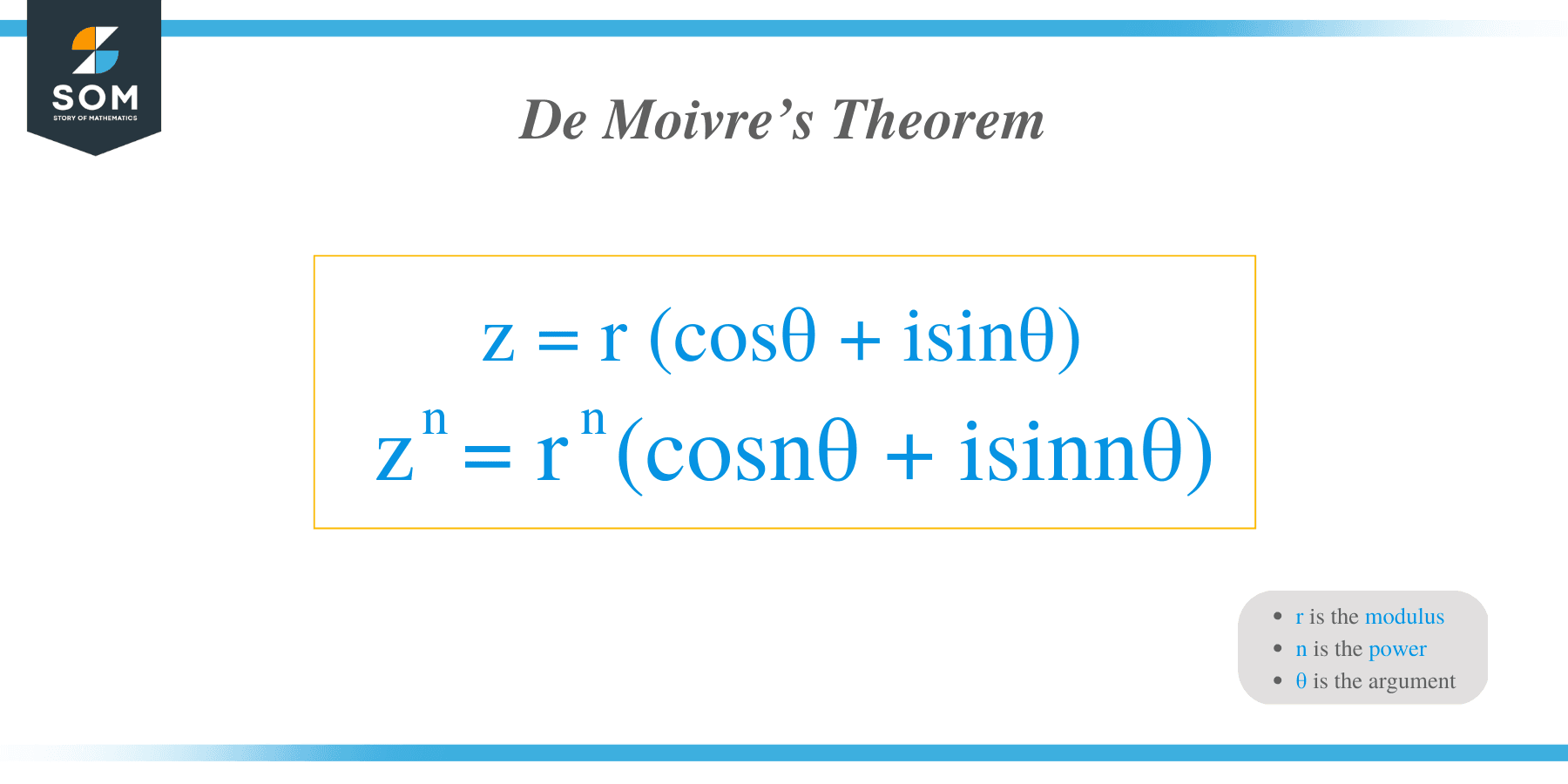
Before diving into the theorem itself, it is essential to understand how complex numbers can be represented using trigonometry. A complex number z = a + bi can be visualized on the complex plane, where a is the real part and b is the imaginary part. This representation can be converted into a polar form using the modulus r and the argument θ. The modulus r is the distance from the origin to the point, calculated as √(a² + b²), while the argument θ is the angle formed with the positive real axis. Using these values, any complex number can be expressed as z = r(cos θ + i sin θ). This trigonometric form is particularly useful for multiplication, division, and especially for raising complex numbers to powers, which is where De Moivre's theorem becomes indispensable.
The trigonometric representation reveals the geometric nature of complex numbers, linking algebra with geometry. When multiplying two complex numbers in this form, their moduli multiply and their arguments add, a property that simplifies many calculations. This foundation makes the transition to understanding powers of complex numbers more intuitive. Instead of repeatedly multiplying the binomial form (a + bi), which becomes messy, the trigonometric form allows us to work with magnitudes and angles directly. This efficiency is the core reason why De Moivre's theorem is such a valuable tool in higher mathematics, engineering, and physics.

The Statement of De Moivre's Theorem
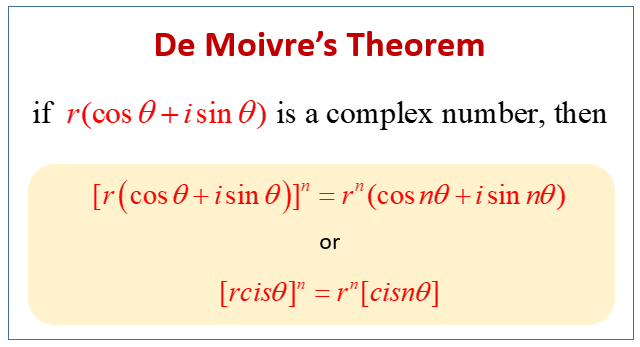
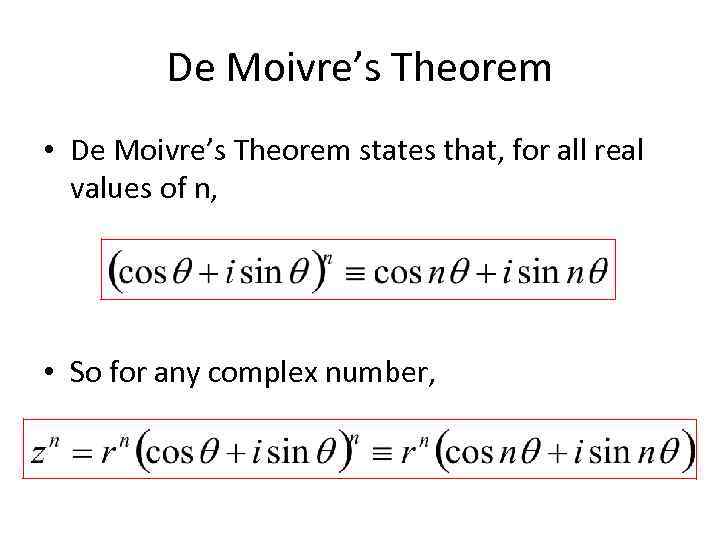
De Moivre's theorem states that for any real number θ and any integer n, the following equation holds: (cos θ + i sin θ)ⁿ = cos(nθ) + i sin(nθ). In essence, the theorem tells us that to raise a complex number in trigonometric form to a power, we simply raise the modulus r to that power and multiply the argument θ by the exponent n. The complete formula for a complex number z = r(cos θ + i sin θ) raised to the n-th power is zⁿ = rⁿ (cos(nθ) + i sin(nθ)). This result transforms a potentially cumbersome algebraic expansion into a straightforward operation involving exponents and multiplication.
The elegance of this theorem cannot be overstated, as it bridges the gap between exponential notation and trigonometric functions. While the theorem is often introduced for integer exponents, its validity extends to rational and even real numbers with appropriate considerations. This versatility makes it a cornerstone of complex analysis. By using this theorem, mathematicians and engineers can bypass complicated binomial expansions and directly compute the result, saving significant time and reducing the potential for algebraic errors.
Application: Finding Powers of Complex Numbers
One of the most common uses of De Moivre's theorem is calculating high powers of complex numbers that would be tedious using the binomial theorem. For example, finding (1 + i)¹⁰ is much simpler when the number is first converted to polar form. The modulus of 1 + i is √2 and the argument is π/4. Applying the theorem, we raise the modulus to the 10th power and multiply the argument by 10, resulting in (√2)¹⁰ (cos(10π/4) + i sin(10π/4)). This simplifies to 32(cos(5π/2) + i sin(5π/2)), which evaluates to 32i. This demonstrates the immense computational power of the theorem.
Using De Moivre's theorem ensures accuracy and speed in calculations involving rotations and scaling in the complex plane. It is particularly useful in electrical engineering for analyzing alternating currents and signal processing, where phasors (complex numbers representing sinusoidal signals) are raised to powers frequently. The ability to easily compute these powers allows for efficient analysis of circuit behavior and wave interactions. Without this theorem, many modern technological applications would be significantly more difficult to model and understand.
Application: Finding Roots of Complex Numbers
De Moivre's theorem is equally powerful for finding the n-th roots of complex numbers, a process that yields n distinct solutions. To find the n-th roots, we take the n-th root of the modulus and divide the argument by n, while also considering the periodic nature of trigonometric functions. The general formula for the k-th root is given by zₖ = r^(1/n) (cos((θ + 2πk)/n) + i sin((θ + 2πk)/n)), where k takes integer values from 0 to n-1. This formula generates all possible roots, which are evenly spaced around a circle in the complex plane.
This application is crucial for solving polynomial equations and understanding the fundamental theorem of algebra. For instance, finding the cube roots of a complex number involves setting n = 3k (0, 1, and 2). The result is three complex numbers that form the vertices of an equilateral triangle centered at the origin. This geometric interpretation provides a beautiful visual understanding of algebraic solutions. De Moivre's theorem thus provides a complete method for extracting roots, revealing the symmetric structure inherent in complex numbers.
Limitations and Historical Context
It is important to note that while De Moivre's theorem is a general and powerful tool, its original formulation applies strictly to integer exponents. Extending the theorem to rational exponents requires careful handling of the multiple values that roots can take. Furthermore, the theorem relies on the periodicity of sine and cosine functions, which is why the root formula includes the term 2πk to account for all possible angles that represent the same point on the unit circle. Despite these nuances, the core principle remains a reliable method for simplifying complex arithmetic.
The theorem is named after Abraham de Moivre, a French mathematician born in 1667 who made significant contributions to probability theory and trigonometry. Although he stated the theorem for integer exponents, it was later mathematicians who rigorously extended its validity. Understanding its history helps appreciate how mathematical concepts evolve. Today, it remains a fundamental technique taught in pre-calculus and complex analysis courses worldwide, proving that a 300-year-old theorem can still be highly relevant in modern science and mathematics.
Conclusion
De Moivre's theorem stands as a testament to the beauty and utility of mathematics, transforming complex calculations into simple trigonometric operations. By connecting the algebraic and geometric interpretations of complex numbers, it provides a clear pathway for computing powers and roots. Mastering this theorem unlocks a deeper understanding of the complex plane and its applications across various scientific fields.
Complex Numbers In Polar - De Moivre's Theorem
This precalculus video tutorial focuses on complex numbers in polar form and de moivre's theorem. The full version of this video ...
