Hoag's Object Galaxy
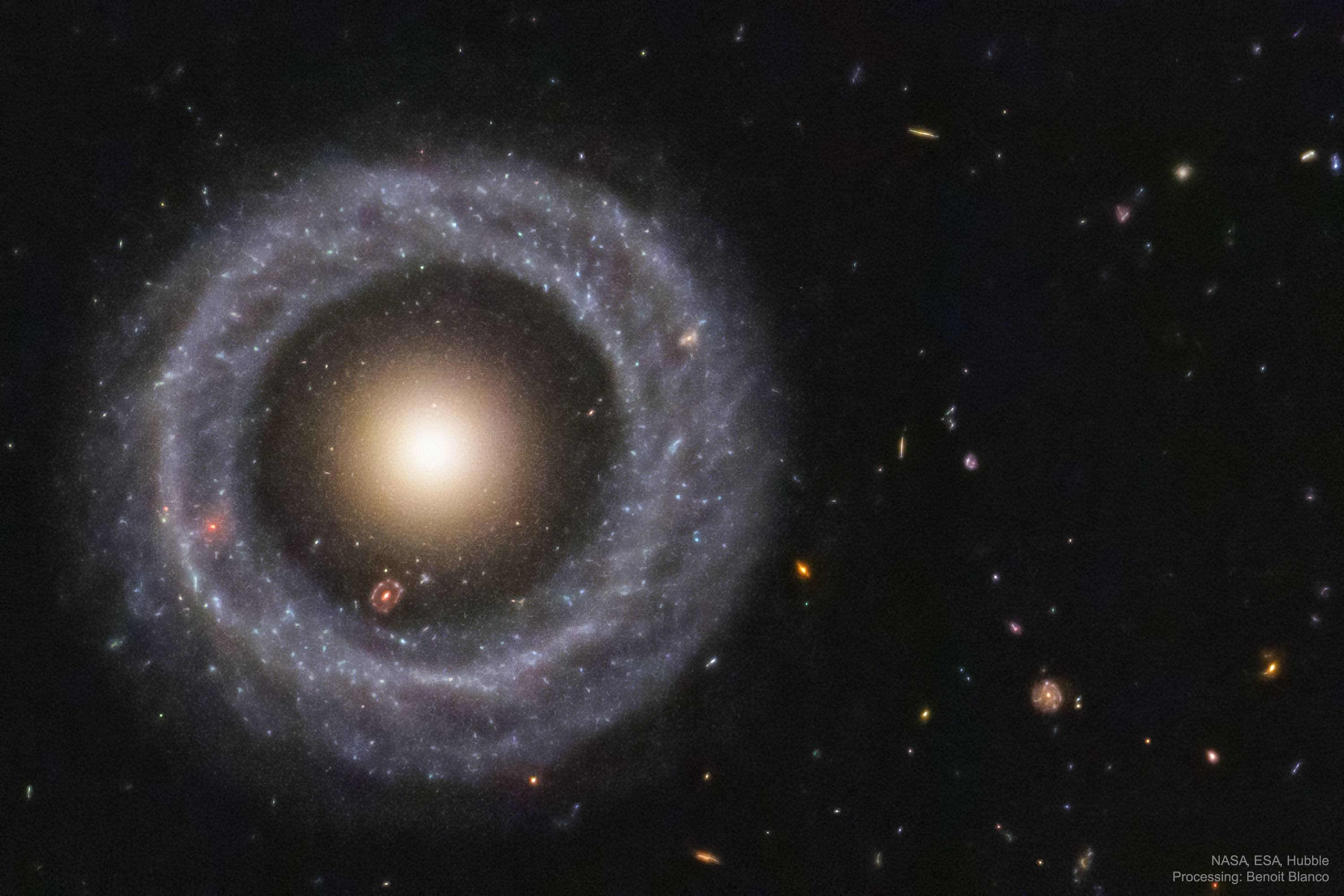
Hoag's Object galaxy is one of the most visually striking and puzzling ring galaxies ever captured by telescopes, presenting a near-perfect ring of vibrant blue stars encircling a smooth, bright nucleus. This cosmic oddity, discovered in 1950 by astronomer Arthur Hoag, continues to fascinate both professional researchers and space enthusiasts because of its almost surreal symmetry and the mysteries surrounding its formation. Unlike typical spiral galaxies, Hoag's Object appears as a dazzling cosmic target with an outer ring sharply separated from the inner core, creating an illusion more like a carefully designed painting than a natural structure shaped by gravity. Understanding this unique ring galaxy offers valuable insights into galactic evolution, collisions, and the delicate dance of stars, gas, and dark matter across billions of light-years.
Discovery and Early Observations
In 1950, when Arthur Hoag first spotted this unusual object, the technology available was far less advanced than today's instruments, yet the peculiarity of the structure was immediately apparent. The original photographic plates revealed a sharply defined ring of young, hot stars with very little visible matter in the gap between the ring and the central body, a feature that defied simple classification at the time. Early hypotheses suggested a variety of explanations, including gravitational lensing or a chance alignment of unrelated objects, but follow-up observations confirmed that Hoag's Object was a single, self-contained galaxy. Over the decades, improved imaging from ground-based observatories and space telescopes has only deepened the mystery, highlighting the importance of this discovery in the broader study of galactic morphology.
Structure and Physical Characteristics
The most iconic feature of Hoag's Object galaxy is its nearly perfect circular ring, spanning roughly 120,000 light-years, with a diameter larger than our own Milky Way, while the central nucleus is a relatively small, bright ball of older stars. The ring itself is composed predominantly of young, massive stars that emit intense blue and ultraviolet light, indicating recent episodes of star formation that contrast sharply with the older, yellower stars dominating the core. The gap between the ring and the nucleus is remarkably empty, containing very little interstellar gas, dust, or visible stars, which makes the structure appear almost like a cosmic bullseye set against the dark fabric of space. This distinct separation has led astronomers to model the galaxy as a double-ring system, where the outer ring may represent the visible edge of a much larger, more tenuous structure that has been sculpted by complex gravitational interactions.

Formation Theories and Galactic Dynamics
One of the leading theories explaining Hoag's Object galaxy involves a past collision or near-collision between two galaxies that occurred hundreds of millions of years ago, when the universe was already well past its infancy. In this scenario, a smaller galaxy might have passed directly through the center of a larger spiral, triggering a density wave that propagated outward and compressed gas into the luminous ring we observe today. Such collisional ring galaxies are rare because they require a precise alignment and timing, making systems like Hoag's Object natural laboratories for studying how gravity reshapes stellar populations and interstellar material. Alternative models explore the possibility of internal secular processes, such as resonant oscillations within a dynamically hot disk, but these mechanisms struggle to explain the extreme sharpness of the ring and the clean division between the core and the surrounding stellar population.
Comparisons with Other Ring Galaxies
While Hoag's Object is the namesake and one of the most famous examples of its class, other galaxies such as the Cartwheel Galaxy and the Antennae Galaxies also display ring-like features, though with more chaotic structures and ongoing interactions. The Cartwheel Galaxy, for instance, shows a series of expanding rings and prominent tails, suggesting a more violent merger history compared to the apparently more tranquil architecture of Hoag's Object. These comparisons highlight a spectrum of ring galaxy types, from those formed by minor mergers to others that might arise from internal instabilities or even dark matter dynamics that are not yet fully understood. By comparing these systems, researchers can test models of how angular momentum, gas content, and environmental factors shape the evolution of galaxies across cosmic time.
Modern Research and Future Observations
Modern telescopes, including space-based observatories with advanced spectrographs, continue to study Hoag's Object galaxy in multiple wavelengths, from radio emissions to high-energy X-rays, in order to map the distribution of gas, young stars, and dark matter with unprecedented precision. Ongoing research aims to refine the timeline of the galaxy's formation, determine whether the ring is currently expanding or stable, and explore subtle asymmetries that might hint at unseen companions or tidal debris. Future observations with upcoming instruments could reveal more about the stellar populations in both the ring and the core, providing clues about the initial conditions and the complex interplay of forces that created this cosmic wonder. For both scientists and amateur astronomers, Hoag's Object remains a powerful symbol of how much beauty and intrigue still awaits discovery in the night sky.

Conclusion
Hoag's Object galaxy stands as a remarkable celestial puzzle, combining aesthetic elegance with scientific intrigue in a way that few other galaxies can match. Its nearly flawless ring structure challenges simple explanations and invites continuous re-examination as new data and modeling techniques become available. By studying this unique ring galaxy, researchers gain insights not only into its own history but also into the broader processes that govern galaxy formation, interaction, and transformation across the universe. Whether viewed through professional observatories or imagined in the minds of curious observers, Hoag's Object continues to inspire wonder and deepen our understanding of the dynamic cosmos we inhabit.
Hoag's Object: The Strangest Galaxy in the History of Science
Join us as we dive into the enigmatic beauty of Hoag's Object—a rare and fascinating type of ring galaxy located 600 million ...
