Picasso's Guernica Painting

When we talk about Guernica, we refer to one of the most powerful and moving artworks of the twentieth century, a monumental painting by Pablo Picasso that confronts us with the raw horror of war.
The Historical Context: A Bombing That Shook the World
Guernica was created in direct response to a brutal event during the Spanish Civil War. On April 26, 1937, the market town of Guernica in the Basque Country was subjected to a devastating aerial bombing by German and Italian warplanes fighting on the side of the Nationalists. This attack, which lasted for hours, targeted a civilian population that had gathered for a market and a traditional fair, resulting in a massive loss of life and the virtual destruction of the town. News of the slaughter spread quickly, shocking the international community and generating widespread outrage. Picasso, who was living in Paris at the time and was commissioned to create a mural for the Spanish Republic's pavilion at the 1937 Paris International Exposition, felt a profound responsibility to translate this tragedy into art. The painting became an immediate and universal symbol of the suffering inflicted upon innocent people during wartime.
Visual Analysis: Disruption and Anguish in Monochrome
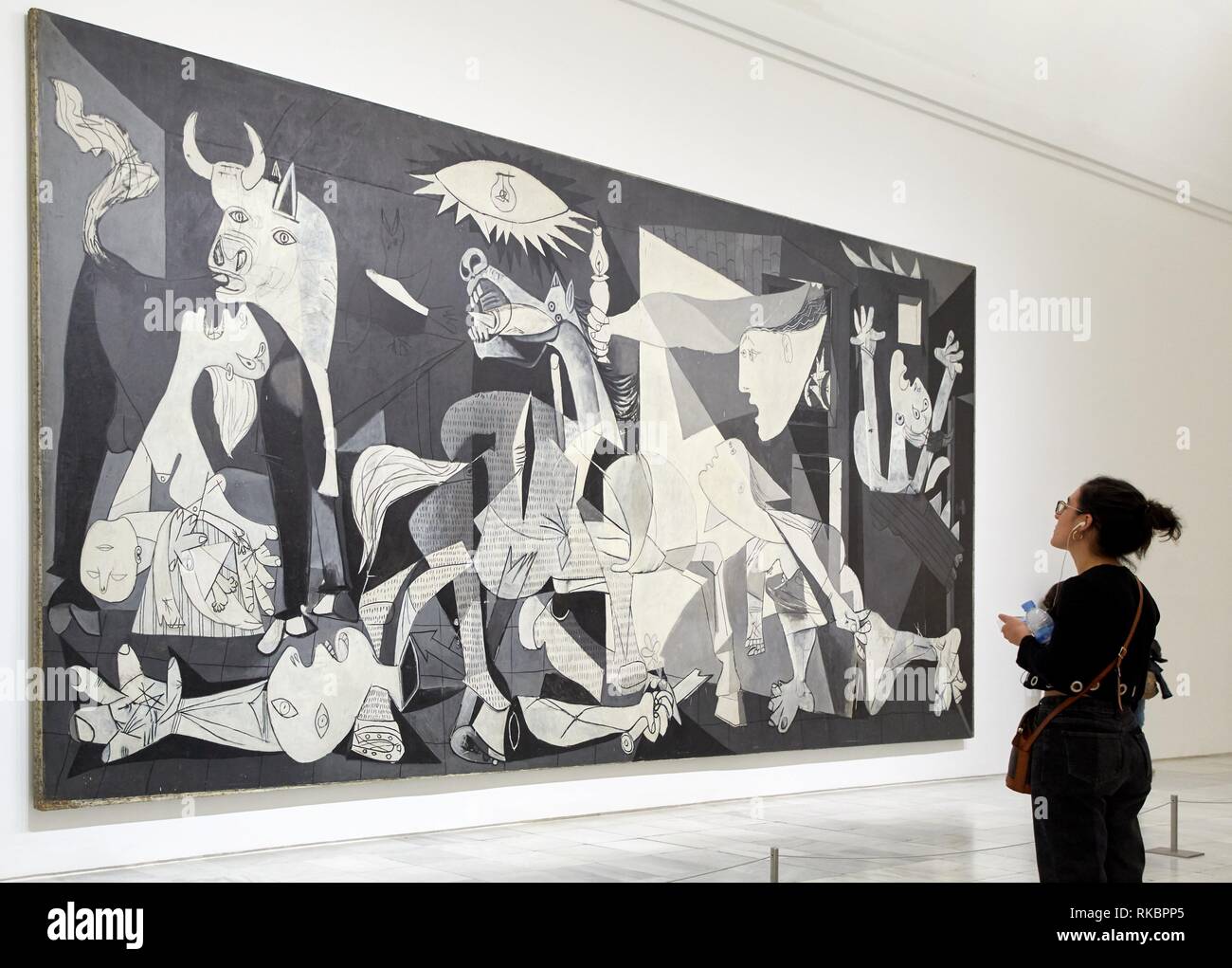
Upon first encountering Guernica, viewers are immediately struck by its overwhelming scale and its stark monochromatic palette of black, white, and shades of gray. This deliberate choice evokes the starkness of newspaper photographs of the era and lends the scene a timeless, documentary quality. The composition is densely packed with fragmented and distorted figures, creating a sense of chaos, terror, and disorientation. A central bull, its eyes closed in anguish, stands opposite a grieving mother holding her dead child, while a wounded horse screams in the foreground. The painting is filled with sharp, geometric shapes and overlapping planes that fracture the space, making it impossible to find a stable vantage point. This deliberate visual language of Cubism is pushed to an extreme, mirroring the shattering of lives and the destruction of the town. Every element, from the broken sword in the hands of a fallen warrior to the light bulb in the upper left that seems to stare down like a malevolent eye, is charged with symbolic meaning.
The Symbolism: Animals, Light, and Martyrdom
While Guernica is not a depiction of specific individuals, the figures within it are drawn from a rich symbolic vocabulary that transcends the immediate event. The bull, often interpreted as a symbol of brutality and darkness, stands as a mute witness to the carnage. The fragmented horse, its body pierced by a spear and anguished mouth open in a silent scream, embodies the innocent victims caught in the violence. The figure of the woman holding a dead baby is a direct reference to classical depictions of mourning, like the Pietà, emphasizing the profound grief and martyrdom of the innocent. Other recurring motifs carry specific weight: the dismembered soldier clutching a broken sword speaks to the defeat and helplessness of armed resistance, while the woman in the window, lit by the harsh light bulb, suggests a search for hope or a final, horrified witness. Even the lamp held by another woman, shaped like an eye, adds to the theme of watching and witnessing. Picasso masterfully uses these symbols to create a complex narrative that is at once specific to the bombing and universally about the suffering caused by violence.
Global Impact and Enduring Legacy
From its first display, Guernica moved far beyond the walls of the Spanish Republic's pavilion to become a global icon of anti-war sentiment. Picasso insisted that the painting should not return to Spain until democracy was restored, and it consequently traveled the world as a powerful piece of political art. During the Cold War, it was exhibited in cities from New York to Stockholm, serving as a poignant reminder of the consequences of fascist aggression. The painting's image has been reproduced countless times in protests, on posters, and in popular culture, solidifying its status as a universal shorthand for the tragedies of war. Its stark imagery has influenced generations of artists and activists who seek to give voice to victims of conflict. Today, a visit to the Museo Reina Sofía in Madrid to see the original canvas is considered a pilgrimage for many, a testament to the work's undiminished power. Decades after the bombing, Guernica continues to resonate, asking urgent questions about the nature of violence, the responsibility of the artist, and the fragile nature of peace.
Guernica as a Political Weapon
One of the most remarkable aspects of Guernica is its function as a political weapon. Picasso, a committed Republican, used his art to take a firm stance against the Nationalist forces and the international powers that enabled their brutality. The painting is a form of visual journalism, distilling the horrific reality of the bombing into a single, unforgettable image that could be understood across language barriers. It served to expose the lies of propaganda and to give a face to the faceless victims. In an era before 24-hour news cycles, the painting performed the crucial role of bringing a distant atrocity to the forefront of the global conscience. Its message was clear and uncompromising: war is not a glorious adventure but a senseless massacre of the vulnerable. This unflinching political message is what has ensured the painting's longevity; it remains a vital reference point in discussions about human rights, military aggression, and the ethics of artistic engagement with political crises.
/Picasso_Guernica-56a6e75f5f9b58b7d0e56a79.jpg)
The Painting's Journey to Today
After its debut in Paris, the journey of Guernica was as dramatic as the painting itself. Following the end of the Spanish Civil War and the rise of Franco, the painting remained in exile, housed primarily at the Museum of Modern Art in New York for safekeeping. It was not until 1981, six years after Franco's death and during Spain's transition to democracy, that the painting finally returned to Spain. Its home became the Museo del Prado and, later, the Museo Reina Sofía in Madrid, where it is now permanently displayed. The physical history of the canvas is also marked by the violence of its subject matter; the painting was attacked in 1974 by a vandal who defaced it with the words "Kills Kill," and it was later protected by bulletproof glass following a 1998 acid attack attempt. These acts of vandalism only underscore the continued relevance of the painting's message. Seeing Guernica in person is an experience that transcends art history; it is a confrontation with the darkest aspects of human nature and a powerful testament to the enduring need for compassion and peace.
In conclusion, Guernica is far more than a famous painting; it is a profound historical document, a masterclass in artistic expression, and a timeless anti-war manifesto. Picasso's genius lies in his ability to fuse formal innovation with deep emotional and political resonance, creating a work that continues to speak to the horrors of conflict and the resilience of the human spirit. As long as war exists, the questions posed by this monumental canvas will remain as relevant and necessary as ever.
Guernica de Picasso: A Grande Arte Explicada
Meu outro canal, Great Books Explained, aqui - https://www.youtube.com/@greatbooksexplained371 Considere apoiar este canal no ...
