De Moivre's Formula

De Moivre's formula elegantly connects complex numbers and trigonometry by expressing powers of a complex number on the unit circle.
Understanding Complex Numbers in Trigonometric Form
Before diving into De Moivre's formula, it is essential to revisit the trigonometric or polar form of a complex number. A complex number z = a + bi can be represented in the complex plane, where a is the real part and b is the imaginary part. Instead of using rectangular coordinates, we can describe the same point using its distance from the origin, called the modulus r, and the angle θ it makes with the positive real axis. This representation is written as z = r(cos θ + i sin θ), where r is always a non-negative real number.
The modulus r is calculated using the Pythagorean theorem as the square root of a² + b², and the angle θ is determined by the arctangent of b/a. This form is particularly useful for multiplication and division of complex numbers because multiplying their moduli and adding their angles is simpler than expanding binomials. When the modulus r equals 1, the complex number lies on the unit circle, and the formula simplifies to cos θ + i sin θ, which is the perfect foundation for De Moivre's theorem to shine.

The Statement and Elegance of De Moivre's Formula
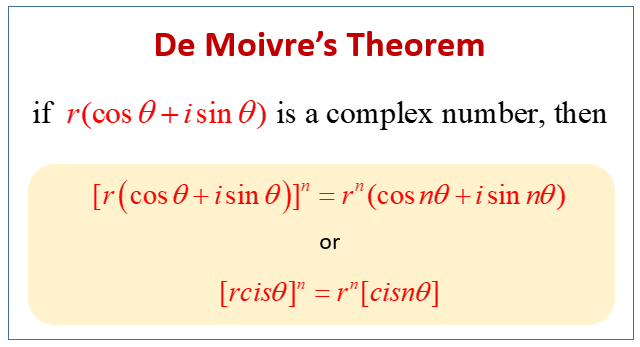
De Moivre's formula provides a direct way to compute powers and roots of complex numbers without resorting to lengthy algebraic expansions. The formula states that for any real number θ and any integer n, the following relationship holds: (cos θ + i sin θ)ⁿ = cos(nθ) + i sin(nθ). This elegant equation shows that raising a complex number on the unit circle to a power merely multiplies its argument by that power while keeping it on the unit circle.
The beauty of this result lies in its simplicity and utility. It transforms a problem that might require binomial expansion into a straightforward application of angle multiplication. Whether n is a positive integer, a negative integer, or even zero, the relationship holds true, making it a versatile tool in complex arithmetic. This formula essentially bridges the gap between algebraic operations on complex numbers and the geometric interpretation of rotation and scaling in the plane.
Proof by Mathematical Induction
The standard method to confirm the validity of De Moivre's formula for all integers involves mathematical induction, a powerful proof technique. For the base case, when n = 1, the statement is trivially true, as both sides reduce to cos θ + i sin θ. Next, we assume the formula is true for some arbitrary positive integer k, meaning we assume (cos θ + i sin θ)ᵏ = cos(kθ) + i sin(kθ).

To prove the statement for k + 1, we multiply the assumed equation by cos θ + i sin θ. The left side becomes (cos θ + i sin θ)ᵏ⁺¹, and the right side becomes (cos(kθ) + i sin(kθ))(cos θ + i sin θ). By applying the trigonometric identities for the cosine and sine of a sum, specifically cos(α + β) = cos α cos β - sin α sin β and sin(α + β) = sin α cos β + cos α sin β, the right side simplifies directly to cos((k+1)θ) + i sin((k+1)θ). This completes the inductive step, confirming the formula for all positive integers n.
Applications in Finding Roots and Simplifying Calculations
One of the most frequent uses of De Moivre's formula is in finding the n-th roots of complex numbers. To find the n-th roots of a complex number, we first express the number in trigonometric form. We then apply the formula in reverse, taking the n-th root of the modulus and dividing the argument by n. Crucially, because angles are periodic, we must add integer multiples of 2π to the original argument before dividing to find all n distinct roots.
Beyond roots, De Moivre's formula is instrumental in deriving trigonometric identities. By expanding (cos θ + i sin θ)ⁿ using the binomial theorem and then applying De Moivre's formula, one can equate the real and imaginary parts to derive formulas for cos(nθ) and sin(nθ) in terms of powers of cos θ and sin θ. This provides a systematic way to generate identities for multiple angles, which are valuable in both pure and applied mathematics.

Limitations and Extensions
It is important to note that the classic statement of De Moivre's formula applies specifically to complex numbers with a modulus of 1, although it can be easily extended to any complex number by incorporating the modulus r[r(cos θ + i sin θ)]ⁿ = rⁿ(cos nθ + i sin nθ). This extension maintains the core principle that angles are multiplied while moduli are exponentiated.
While the formula is typically introduced for integer exponents, its connection to Euler's formula, e^(iθ) = cos θ + i sin θ, reveals a deeper truth. Using Euler's notation, De Moivre's formula becomes the simple exponential law (e^(iθ))ⁿ = e^(inθ), which holds true for any real or even complex exponent n. This highlights how De Moivre's theorem is a specific, accessible case of the more fundamental properties of the exponential function in the complex plane.
Conclusion
De Moivre's formula remains a cornerstone of complex number theory, celebrated for its elegant simplicity and profound utility. It provides a powerful link between algebra and geometry, allowing for the straightforward calculation of powers and roots of complex numbers. By transforming multiplication into addition of angles, it demystifies operations that would otherwise be computationally intensive, solidifying its lasting importance in mathematics.
Complex Numbers In Polar - De Moivre's Theorem
This precalculus video tutorial focuses on complex numbers in polar form and de moivre's theorem. The full version of this video ...
